As of 2012
The Best Bike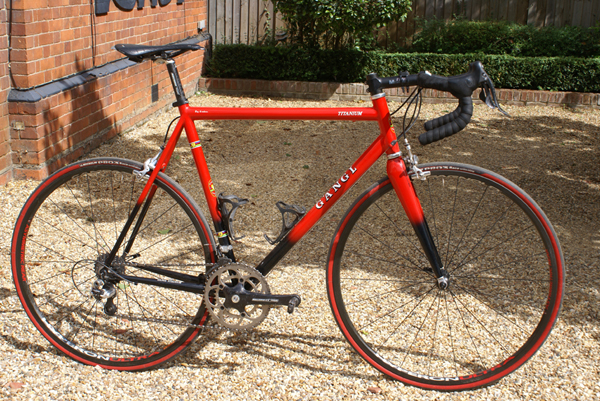
|
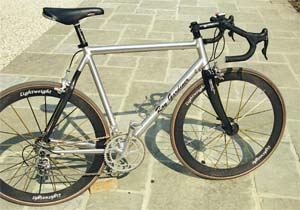
This is the only Gangl outside America, handmade and finished by Richard Gangl1 in
his workshop in Colorado. The frame is entirely titanium, the forks carbon fibre.
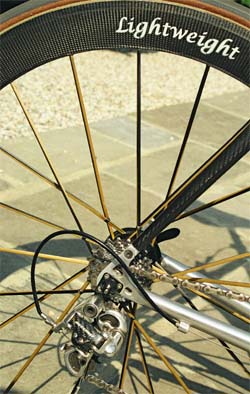
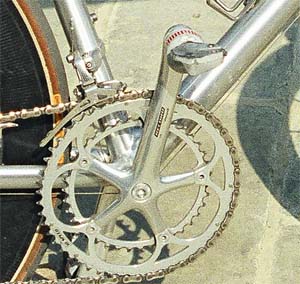
The wheels are Campagnolo Hyperon Ultra clinchers. I traded the Lightweights (see below) simply because I didn't get enough use out of them; being tubs, I used them only for racing, whereas the Hyperons I use all the time (when it's dry...). Saddle is Specialized Toupe, the only saddle I could ride prior to getting my knees fixed (I sat funny and got awful saddle soreness). Pretty much everything else is Campag Record 10-speed. You see a compact 34/50, for the summer I swap it for an FSA carbon 39/53 set-up which looks even better. Weighs in at 8kg. 1Rich said 'I'm thinking of making Aluminum frames' and my brain said 'Interesting.' and my mouth said 'I'll have one'. When we finally got the spec finished, I'd changed my mind to titanium. Best decision ever. |
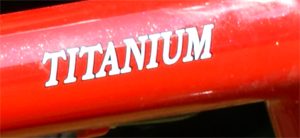
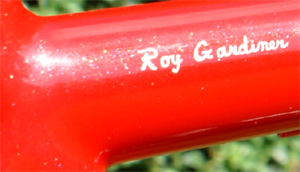
The finish really does sparkle like that in the sun. | |
The Time Trial Bike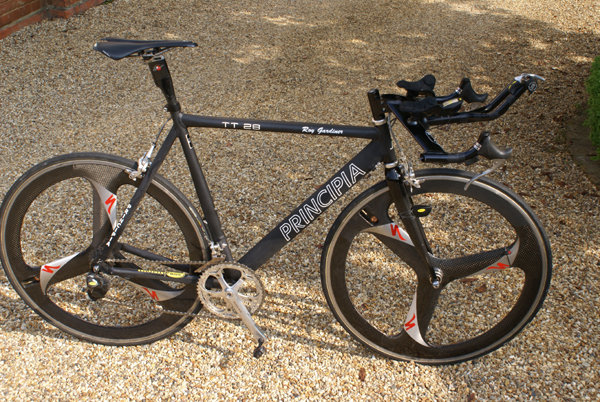
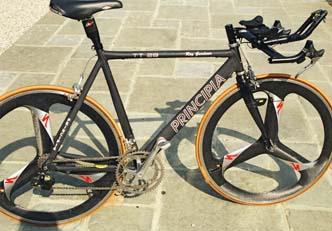
| I have had this bike since 1999, yet it's probably done fewer miles than any others of
mine, perhaps 1,000 miles or even less. This is because I only ride 10s and don't ride that many of
them any more.
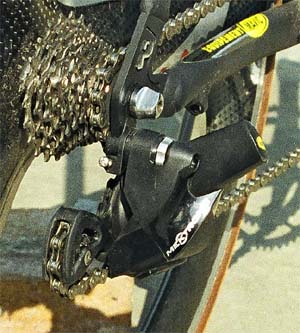
It's a Principia TT28, aluminium with carbon-fibre forks, Mektronic electronic gears (Dura-Ace compatible) 9-speed, 11-21. Dura-Ace chainset with currently 46-50, hopefully to go back to 48-53 as it was when I went a tiny bit faster.
|
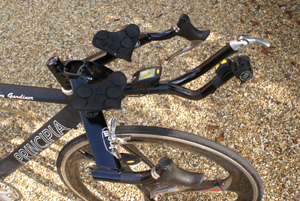
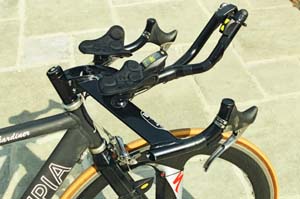
| Aero bars are essential on a time-trial machine. Electronic shifting allows gear levers to be both on the inner and outer grips of the bars. |
Best Bike 1992; Training bike 2012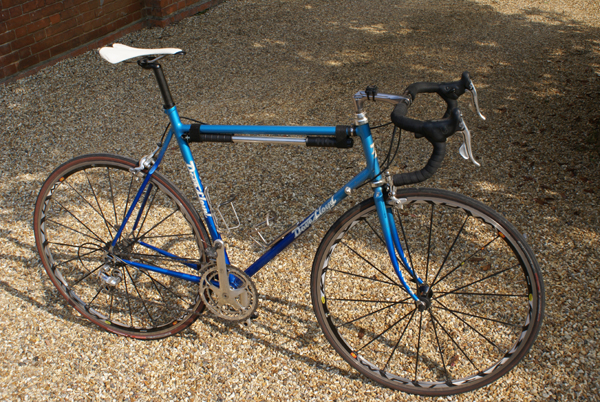 |
Dave Lloyd is one of the best cyclists this country has produced. See his
Home pagefor more. When he retired he
went into bike frame building, so I bought one. It's a beautifully smooth ride, and now that I've
brought it up to date from the 8-speed gearing of 1992 to 10-speed today it has an easy, friendly
gear set up too.
The finish, blue over blue, was my own choice so don't blame Dave, but I like it and it's lasted pretty well. The front and rear ends are chrome, which I thoroughly recommend. The Ksyriums I've had since 2003 and used to be my best wheels, but now the Hyperons obviously take precedence. They (Ksyriums) have run straight and true without any adjustment all that time, used for many years in Majorca and for my End-to-End attempt. Can't praise them highly enough. Now I use Specialized Armadillo tyres (I don't like punctures on training rides!) yet still carry a full-size pump on the frame, just in case. |
Winter bike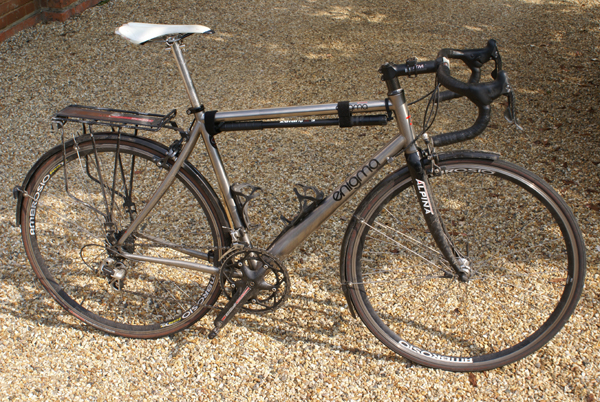 |
For a while I had two race-quality road bikes (long story...), the Gangl and an Ambrosio
carbon-fibre framed
example. But I barely need one racing bike, two is silly. I started to use the Ambrosio as a
winter bike, which was a bit daft. So I traded the frame for a titanium Enigma Etape and
transferred most of the bits onto it to make up a proper winter bike.
The Ksyriums went to the Dave Lloyd 2nd best, and some old Ambrosio clinchers were pressed into service. Again I am very happy with this bike, it's immensely comfortable, handles cleanly and isn't as heavy as it might be. A carbon chainset is a bit over the top for a winter machine, but there's no point in not using it. So, as of 2012 it's four bikes, each with a bit of history. Well I think so anyway. |